The Online Mod/ern/ist Archive

archive of original modernist recollections and information .
we are glad to hear from anyone with memories of the time, but we do not rewrite history .

28 Feb 2008

Gay London at Le Duce


Haydon Bridge's history of gay clubbing in London

The 60's - In which queers shift their traditional allegiance from prostitutes to the black community; Italy and France influence the style of the secretly queer mod movement; and the partial legalisation of homosexuality makes no difference to the London queer scene - or does it ?

Peter Burton (centre) and his sister Pamela and friend Stevie posing in D'Arblay Street 1967

where we went

Are you ready for the story of gay clubbing in London – more than 50 years of sex, drugs and rock ‘n’ roll?

Yes, we really have been partying for that long - even before the first discothèque opened in 1960.“There’s a great myth that gay life didn’t start until 1967,” says Peter Burton, who ran
the gay mod club, Le Duce, which writer Alkarim Jivani calls “one of the trendiest places to be seen in London.”

“Amber”, now 71, arrived in Soho in 1948 at the age of 13. He can reel off a list of queer bars in Soho in the 50s:“The Alibi, the Huntsman, Take 5, The Apple, No. 9, the Casino. You didn’t have to go 100 yards.

We had more places then than now.”

Most of the bars were in basements and attics.They were tiny, but some had a juke box and people would dance.Amber reminisces about the Mambo in Greek Street. He must have been there in 1956 because Fats Domino’s ‘Blueberry Hill’ was on the juke box:

“It was the pits.

When they all started jiving, you could see the floor going up and down.”

Ironically, the Wolfenden Report, which recommended to the Government in 1957 that “homosexual behaviour between consenting adults in private should no longer be a criminal offence”, made life more difficult for queers.

Homophobic police stepped up raids on queer meeting places.They rarely made arrests, but intimidated everyone by taking names and addresses.

Corrupt cops also took cash and booze from bar owners. Queers took refuge in illegal drinking clubs.

Gay activist, Claire Andrews, remembers, “They were usually run by black people, who were sympathetic to lesbians and gay men who didn’t have a place to go.”

In 1964, when homosexual law reform had become inevitable, the Director of Public Prosecutions warned the police to ease up. But by that time gay life in Soho had been decimated.

It wouldn’t recover until the late 80s. In a double irony, the renowned Le Duce was co-owned by an ex-cop, Bill Bryant.

In 1964, he and his partner, Geoffrey Worthington, had opened a discreet queer bar, The Lounge, in Whitehall. It didn’t work, and the pair moved to Soho’s D’Arblay Street, where they got the formula right with their queer version of the nearby straight mod club,The Scene.

Like their hetero counterparts, queer mods wanted to dance non-stop (and had the drugs that enabled them to).

Le Duce was open all night every Saturday.The basement room had a door policy that kept the club fashionable (and predatory older men out).Working class poofs and straight dolly birds danced to black music – Jamaican blue beat,Tamla Motown.

“They spoke directly to us,” says Peter Burton, who was in charge from 1966 to 1968, when he
moved on.

By then Soho had been carved up by East End and Maltese gangsters, who were getting rich from hetero strip clubs and clip joints.

The queer scene moved to West London, where it was to thrive in the 70s. Incredibly, a prototype back room operated at the Gigolo in King’s road, Chelsea, from 1967.

“It was a long cellar and everyone would cram up the far end,” recalls gay historian Dr David Lawrence.“The lights were dim. It was like a scrum. Nobody ever came up and stopped anything.”

Alan Jones, co-author of disco history, Saturday Night Forever, is more explicit.“The first time I was ever given a blow job was in the Gigolo,” he reveals.

Meanwhile, in 1967, homosexuality was made legal according to the Wolfenden recommendations. It was little more than a rubber stamp.“It never changed my life in any way,” declares Amber.“It didn’t provoke a rush of new clubs,” agrees Peter Burton. But drag legend Pip Morgan feels that after 1967 there was a subtle change.“You used to keep an eye open for people who were in trouble,” he says regretfully.

“But when everyone could do what they wanted, people stopped being nice to each other.”

what we wore

“GROWING up gay and realising that one is different means a constant questioning of who you are,” says “John”, interviewed by the Victoria and Albert Museum’s Shaun Cole.“Experimenting with clothes is a way of exploring this difference, a way of showing or accepting your difference.”

Aged 15 in 1960, Peter Burton “favoured shirts in delicate pastel colours (lilac was a firm favourite)…a bouffant hairstyle and a tortoiseshell cigarette holder.” This dandy look, popular since Quentin Crisp’s heyday, was superseded by the Continental style, promoted to London queers by Bill Green, a former physique photographer, who opened Vince Man’s Shop in Soho in the 50s.

... Next to advertisements for John Stephen - Man alive published such ads for Domino mail order - fantastic text ...


On a trip to the South of France, he noticed such novelties as black jeans and tight swimming trunks. Rome’s ‘Dolce Vita’ period at the turn of the 60s was the next big influence.

Within months of the film’s premiere,Vince marketed “bum freezer” jackets, drain-pipe trousers and winklepicker shoes.

Green’s sales assistant, John Stephen, left to open His Clothes, around the corner in Carnaby Street. Stephen developed his own style, accentuating the male form even further by lowering trousers from the waist to the hips and minimising underwear (“hipster briefs”) accordingly.

This sexy and essentially queer look was appropriated by the mainstream rag trade to dress the mod era, big from 1963-6, when The Beatles helped to make London the most swinging city in the world.

By 1967 mods had been replaced by hippies with unisex clothes and shoulder-length hair. For the rest of the decade it was often difficult to determine gender, let alone sexuality. But this situation began to change around 1969, when some working class lads reacted to hippie androgyny by shortening their hair and wearing braces.

Were these first skinheads as gay as the skins at Hard On?

“They were always gay!” laughs Alan Jones.

“Braces! Even then it was a gay code.”

what we listened to

For decades working class queers and female prostitutes formed a natural alliance against the authorities that wanted the trouble makers off the streets and into jail.

But from the early 60s, when the legalisation of “discreet” prostitution and homosexuality became imminent, working class queers began gravitating towards the immigrant community from Jamaica.

This defining relationship between outcast societies can be traced through to the present day (and makes the homophobia of some Jamaican dancehall stars all the more preposterous).

From 1963, both straight and gay mod clubs played danceable records by Jamaican blue beat stars like Prince Buster and Desmond Dekker, music which became part

of the soundtrack of the mod era.

But queers also liked the whole package – the beat, the lyrics and the camp image – of US soul groups like The Miracles, Martha and the Vandellas and especially The Supremes.

At Le Duce the only white music played was “blue-eyed soul” by the likes of Dusty Springfield, who also happened to be gay and made-up like a drag queen.

Although ‘The Green Door’, a hit for both Frankie Vaughan and Jim Lowe in 1956, allegedly refers to a queer bar, the first unequivocally queer song,‘See My Friend’ by The Kinks,
reached number 10 in the British charts in 1965.

For the rest of the decade queers generally ignored protest songs and flower power in favour of bubblegum music, the camp fun of Tiny Tim and Harpers Bizarre, and stuff promoted by gay radio jock Kenny Everett.

Incidentally, all records played in gay clubs in the 60s were on juke boxes. London’s first disco, La Discothèque, and its more successful rival, the Whisky-a-go-go, were in Wardour Street from the early 60s; but there was no openly gay club night in the capital until Tricky Dicky (richard Scanes) began at the Father Redcap in Camberwell in 1971.

how we danced

The jive and its variations, introduced to the UK during World War II by American GIs, retained its popularity throughout the 50s, but mainly with straight kids.

Queers preferred the rare luxury of dancing arm in arm. everything changed in the early 60s, with the arrival of the twist, first popularised in New York’s Peppermint Lounge,“a gay hustler joint, frequented by sailors, lowlifes and street toughs in leather jackets,” says DJ historian Bill Brewster.

The first dance in which partners didn’t hold each other, the twist was perfect for queer bars.

When the police arrived, dancers quickly turned towards a person of the opposite sex.

Unfortunately, this didn’t work when the pretty police were on the floor.

In 1962, David Browne, manager of the Kandy Lounge in Gerrard Street, was hauled into Court because the club had been “visited by plain clothes policemen who observed men dancing the twist with each other.”

Browne’s counsel maintained that the men concerned were dancing the madison, in which people of the same sex formed a line.

It didn’t wash. Browne was found guilty.

The twist spawned several variations - the fly, the mashed potato, the locomotion, the pop pie – whose names were more familiar than their steps. (When Kylie revived the Locomotion in 1988, nobody could be found who remembered Little eva’s original dance).

In 1963, despite the continuing success of the twist, its prime exponent, Chubby Checker, turned his attention to the limbo.The next major development was the blues, the first of the “standing still and twitching” dances, supposedly invented by Dave Clark as a publicity stunt for his record ‘Do You Love Me?’ (1963).

It became the mods’ favourite dance, and was later “mod”ified into the hitch-hiker and the shake.The latter superseded the twist, but by the end of 1965 it had evolved into the frug, which became the staple dance of the late sixties.

how we got wasted


AS QX said in 1998,“Queers are always first to discover a new drug.”

And so it’s always been. Most of the queer bars of the 50s and 60s didn’t serve alcohol. Cocaine, which had virtually disappeared before World War II,hadn’t returned.

Therefore queers went in search of new excitement.

A popular destination was the branch of Boots on Piccadilly Circus, which stayed open all night. here you could buy a tube of Preludin, a slimming drug, which delivered a nice buzz for quite a few hours, or a tin of ten amyl nitrate capsules, intended to treat angina.

(You snapped or “popped” the capsule into a hankie and inhaled.

Poppers weren’t widely available in bottles until the late 70s).

Queers and Jamaicans bonded not just because of music but weed.

Cannabis was unknown in the UK until Jamaicans brought it here in 1948.At first it was used only among jazz musicians.

The first drug bust was in Soho in 1952, and this alerted the local queer community.Amber used to buy four ready-made “reefers” (spliffs) for £1.

Amphetamines, notably Benzedrine, were widely used as stimulants during World War II; and under their street names – purple hearts and black bombers were most common – “uppers” became the mods’ favourite drug.

Sleep became difficult without barbiturates (“downers”).

Pip Morgan remembers that the dealers were often girls (they were good at charming prescriptions out of doctors).


Peter Burton says that the fish in the tank at Le Duce kept dying because clubbers threw their pills into the water whenever there was a police raid.


Pip Morgan circa 1966


He also saw clubbers removing the wadding from Benzedrine inhalers and dunking it in Coca Cola, and Samantha the transvestite cat burglar sniffing her wig cleaning fluid.

Queers (or “gays” as we became known from about 1969 onwards) generally remained loyal to uppers and downers well into the 70s.

Lysergic acid (LSD), which arrived around 1966, didn’t suit queer club culture.The swirling patterns and dreamy,jangly music that contributed to the first Summer of Love in 1967 were pretty much a hetero thing.


Originally published in QXmagazine

1 Feb 2008

It was a tribal thing


This writer, a pioneering mod, recalls a world of clubs, cliques and fearless tailoring


IN THE FIFTIES, everybody grew up looking like their parents. It was just so grey. There was no music, no clothes and you didn’t have that many places to go. My sister Gloria, who was four years older than me, was a bit of a Beat, as they were called at the time, and she used to go to London for the coffee bars. The Two I’s was the famous one but there was a whole load of others — the Macabre, the Bastille, Les Enfants Terrible.

This was round about 1959. Then she really got into R’n’B music, people like LaVern Baker, Joe Turner, Ray Charles, the Drifters. Her big favourites were the Shirelles and she actually got to run their fan club, which unlocked a whole lot of things because then she started taking me to the clubs where all this music was going on. I guess I was about 14 and we used to go along with her pal and her brother, Geoff Lewis. So my sister was the one who told me: “Get some pointed shoes,” and got my mother to take up all the turn-ups on my trousers and put buttons on my shirt collar.

I was now a Mod. I used to come up to London and buy clothes but an awful lot of stuff you got made or you made it yourself or you found things in bizarre places. We used to buy cricket whites, cheap cotton ones from C&A, and dye them ourselves — bright yellow, orange — because you couldn’t buy bright coloured clothes.

We would have them shortened by two inches so you could show off your socks. I remember buying a scarlet shirt and my dad saying to me, “Where are you going? Bullfighting?” He’d never seen a scarlet shirt before. My mother was brilliant because she was a dressmaker and she used to make stuff. At the time, we used to go to the Scene club in Ham Yard (Soho) and try and wear something new each week. I would get my mother to make tartan shirts, polka-dot shirts, or maybe one guy down the Scene would have something on and we’d think, “That’s nice” and get it made for the following week. Once I saw something on TV with these American kids’ initials on their shirts. At the time the most sought-after things were these Italian lambswool tops which had a little button at the back of the collar. I got my mother to make some felt letters and she sewed an F for Freddy (my English name) on to one and a C for my mate Cliff on to the other. We wore them down the Scene club and the next week everybody had them. I loved a shop called Austins, that was a real favourite, and we also went to Cecil Gee and Annello and Davide, the shoe people in Covent Garden.

All they made were dancing shoes but they had these shoes with a Cuban heel and a seam down the middle, which was very unusual. I think they were flamenco shoes and somebody saw them and said: “Right, I’ll have those.” This was well before the Beatles.

We used to go to Heathrow airport on our scooters. There was a bowling alley there and the shoes were fantastic, three colours and with your size written on the back. So we would put on our sy shoes and walk out in a pair of these bowling shoes, cost you nothing. Then you would get a coffee late at night in the airport.

Mods were not that interested in groups. We were into records. Monday nights we used to go to the Lyceum in Streatham and the Orchid in Purley, sometimes both on the same night. Tuesday we stayed in. Wednesdays was the Wimbledon Palais, Thursdays it was the Locarno in Streatham. At the weekend the Scene was the big club and then there was the Flamingo where we went to see Georgie Fame whom we really loved. You’d go and see Georgie and you’d think: “What’s this music he’s playing?” So you would go and check out Mose Allison or whoever and that’s how you got put on to various artists. I still see Mose Allison when he’s in town, he’s brilliant. At some of these clubs you would take records along and you’d go up to the DJ and say: “I’ve got the new Maxine Brown single.” They would have a separate deck to preview new tunes and then they’d play your record, which was really cool. The Lyceum in London was a Sunday afternoon dance and that was a big Mod club.

You had to watch it a little bit if you went to clubs in different parts of town that were not your own. You tended not to chat birds up at those places although there weren’t that many good-looking Mod birds to go round.

It was a very male thing. It was also a tribal thing. There was a period when all the East London boys wore blue suits and all the South London boys had grey suits. You had your little teams and you were very stuck up, you were very proud. Fraternising with others was a bit like lowering yourself. It was very insular that way. You wanted to be the one who wore things first, not the one who wore it three weeks later.

In my team there was Denzil (who appeared on the cover of the Sunday Times Magazine, August 2, 1964 – See “Changing Faces” elsewhere on the blog) and Pete Saunders who later became a DJ. The other one who was a pal was Mickey Finn, who got pally with the DJ Guy Stevens and later on teamed up with Marc Bolan in T. Rex.

There were a few fights but unlike what Stan Cohen, the sociologist, says about it all being speed orientated, it wasn’t. People only really took speed at the weekends and they did so to keep awake. Then they started thinking, “This pill isn’t bad,” and stepped up the dosage until they got right out of their boxes.

The end of it was Brighton in 1964 and the riots. Those guys weren’t right. It was all watered down. They’d bought a parka but that was it.

What broke your heart was that it all got so big, plus it didn’t help when the papers blew up the stories about the pills. The centre of gravity moved from Carnaby Street, which was now exploiting people, to the Kings Road, and that became the new scene. For me it was all over. I pulled out.

From July 28, 2003

29 Jan 2008

Are you a Mod or a Rocker ? - 1963


Pass the test !
(but we won't divulge our results !!)

thanks to Alvaro & Mocky Dimples for this early article from Motor Cycle magazine Dec. 1963


28 Jan 2008

Elegancia 1964


Alvaro & Mocky
Dimples have sent these great scans of a Spanish magazine called Blanco y Negro dated 11th July 1964.

Thanks !


24 Jan 2008

London Shopping

Back in 1965, US magazine Teen’s Robyn Guest tries to catch what’s left of mod and follow a girls' trio through the streets of London.


Silly article, nice pics.


Christine Rout, Susanne Frost and Louise Freeman are our guides …


CARNABY STREET : A quaint narrow strip of stores that caters to the very get-ahead crowd. This is where the teens trample over each other ever shopping day to buy what they can afford in the latest Mod styles.

Boy-watching is just as popular as window-shopping, at least it seems so for Louise.


The Stephen House caters to record fans as well as to gals who buy the Mod clothes.


Well, let’s have a closer look. HER CLOTHES inside a store for HIS CLOTHES.
Why not ?

It’s common for boys to shop with their girlfriends. Each selects the other’s clothing.

“It’s as much fun to look at the boys’ clothes as it is our own. Lots of times I’ve gone shopping just looking at what the male side of our sex is wearing. That way we can tell which boys are ‘in’ when we meet them at parties or other places.”

(Which shows how Mod logic works.)


22 Jan 2008

Stagger Lee

The Isleys, London mods and a gun ...

18 Jan 2008

Blues in England - Part Two


T-Bone Walker

Live at the Klooks Kleek 1965


by Tony Lennane - From Blues Unlimited - April 1965 Issue


Just a few weeks short Klooks from West Hampstead station is the Railway Hotel, home of Klooks Kleek, a rather posher-than-usual R n’B club.

It is located on the first floor, bars and carpets everywhere: not the kind of place I would have expected to see T-Bone Walker.

See him I did.


This was one of Klooks better nights. By nine pm it was quite packed, though little known to the present generation of beat enthusiasts, there was quite a lot of genuine appreciation evident that night. It was March 9th; the doors were opened at 8.00 pm and we were allowed in for a very reasonable 7/- (how do they manage it ?)

Our first entertainers, and entertain they did, were the “Bluesbreakers” led by John “heart and soul in my music” Mayall, a true musician deeply involved in the true traditions of the American Negro.

I feel just recognition should be given where it is rightly due. Here is a man who knows the music, in fact a true enthusiast of the pure blues, definitely the best group we are fortunate in having here in Britain.*

After having been told of T-Bones appearance having been set for a full hour at the end of the evening between 10 and 11 pm, he appeared without warning at approximately 9 o’clock for the first of the two sets of the day.

First we were to be impressed by a five-minute guitar instrumental which, though, simple in construction , had us all rockin’. Once again credit is due to the boys for a very able backing. T-Bone told me later “they have a true feeling for the blues”.

He liked the boys, as he explained later in the bar, over a gin and orange.

The highlights of the evening were the two numbers he featured on the “Original American Folk-Blues Festival” (Polydor LPHM 237-597), “I wanna see my baby” and “I’m in love”, both among my particular favorites by T-Bone.

Other exciting – if commercial – numbers to be performed for our eager ears included the rock classic of the fifties “Linda Loo”, originally recorded by the now unheard Ray Sharp, and “T-Bone Shuffle”, an item remembered from his Atlantic label employ.

After half-time in yonder bar we pushed our weary way to the front to find John Mayall running through a few popular R n’B items – “My Babe” etc…etc…etc… T-Bone appeared to back John for a few numbers before taking the spotlight himself.

To end the night of unforgettable music we were given a form of Hooker-cum-Reed-cum-Walker “Boogie Riff”. It took 4 encores and nigh on twelve minutes before he finally disappeared behind the door, to appear very briefly with a bow and a broad smile.

This was a night never to be forgotten, and for Klooks Kleek I sincerely hope, a paying one.

More performances by visiting US artists to such as the Kleek club will undoubtedly bring out the best in all of them, thus rewarding the bluesophile with better than the average shows.

T-Bone’s tour of Britain proves to be quite comprehensive, as he is taking in all 3 TV channels and travelling from his London hotel (The Imperial) to perform everywhere from

the Cliffs Pavilion Southend to

the Regency Ballroom Bath, via

Market Hall, St. Albans,

Club-A-GoGo, Newcastle;

Dungeon Club, Nottingham;

Twisted Wheel, Manchester;

The Whiskey-A-GoGo, Birmingham;

Ricky Tick, Windsor;

Doghouse Club, Harrow;

Crawdaddy, Richmond

and many other colourful places with such names as

Cooks Ferry Inn,

Concord South Bank Jazz Club,

Public Hall,

Chelsea College and

Trade Union Hall !

Quite a selection ……

T-Bone spent two evening in full rehearsal with his group at the Marquee Club in Wardour St., London prior to his opening night at the Flamingo, which lacked the spark of his Klooks performance, a night that ignited a blaze of new interest in one of the greatest of old time bluesmen.


* Note that, as the “Bexhill Observer” so rightly says, “Any opinions stated by our correspondents do not necessarily reflect those of the editorial staff.” So don’t plague us with letters (as once happened).

15 Jan 2008

Young Londoners


by Jane Wilson - from Len Deighton's London Dossier


Young Londoners fall into two main groups which are divided by the usual distinctions of age, occupation and money.

First there are the teenagers, referred to generically as ‘mods’. Clearly some are modder than others, but if you watch the crowd scenes in the various television programmes devoted to pop, you will get the general idea of the current fashions in this group. (Boys on these programmes whose fancy dress appears to be fancier than most, and girls of immodest appearance, are probably not mods at all but specially hired to give colour to the proceedings.) Mods like to look as much like one another as possible, and their girls are rather demure. Elder mods are sometimes as old as twenty-two. No one knows what happens to old mods because we haven’t had a whole generation of them yet. Presumably they marry, have children, and settle down to form the backbone of England.

Mods continue to earn more than their parents ever did when young, and they spend their money almost exclusively on pop records and clothes. The correct attitude in this group is exceedingly cool, almost blank. The young girls may scream occasionally at the pop group of their choice, and the boys may have the odd Saturday night or Bank Holiday punch-up, but emotional behaviour or any kind of frolicking is otherwise unseemly. They are not strictly chaste – but the girls are preparing for a white wedding. Mods don’t go to bistros, they prefer the Gold Egg type of restaurant. Wherever you see gigantic orange light fittings and décor which looks like one huge fruit machine, you will know that the mods are inside eating square meals in round buns. Mods’ night-life ends around midnight during the week. They have nine-to-five jobs and live at home, so they don’t go to the expensive late-night discothèques.

The mods are responsible, as principal consumers, for the progress of pop music, and the tabernacle and heart of London’s blood music is the Marquee Club at 90 Wardour Street, w1. The entrance is murky and the air inside is hot, damp and salty. If you really like pop music and can survive in unconditioned air, you should investigate this place…

… The Marquee moved about three years ago from its old premises in Oxford Street to this new larger outfit.

In Oxford Street they used to announce every night how many people were in the club ‘LADIES AND GENTLEMEN – TONIGHT, AN ALL-TIME RECORD! THERE ARE 874 OF US IN HERE!’

The Stones, in the days when they really were dirty, had their first central London club engagement at the old Marquee. Rhythm’n Blues in England began there with the late Cyril Davis, who died a few years ago from pneumonia after being stranded in the rain on the way to a gig somewhere.


His music was much harsher and harder than anything around now, and the Marquee then was not exactly fashionable. There were always a lot of old, ugly and unexplained people around.

Some nights the rucksack-beard-and-bedding-roll group would arrive from hitchin in some unknown Thumb Country, and there was usually a sort of habitué circle of Negroes with hip flasks dancing in front of the bandstand.

The Negroes have moved on now to the Flamingo and All-Nighter Club in Lower Wardour Street, home of Georgie Fame & The Blue Flames, and Zoot Money and The Big Roll Band.

The hitch-hikers have disappeared altogether from the beat-club scene. They were the extremist end of the Rocker tribe, which is now almost extinct. But you can still see nomads in Trafalgar Square outside the National Gallery on a summer afternoon.

They are filthy and hairy and lost, and they sit there nursing their blistered feet after a trek from god knows where. Most of them grow out of it and get over it, but they suffer for their art and make a change sometimes from the neat little mass-produced mods.

These mods, the ones who care more about The Look than The Sound, congregate nightly at a place called Tiles just a block down Oxford Street from Tottenham Court Road.

The music of Steve Darbishire and The Yum Yum Band, or of Everett of England, or the Anteeks, is relayed out into the street via speakers placed in neighbouring shop doorways.

Inside they dance actively, and spend their money in the night-time shops built in the maze of corridors that surround the main dance floor. The birds’ clothes shop is called Plumage, and if you’re not a success on arrival you can nip in there and come out again in something new.

On nights when there’s no live music they still crowd near the bandstand and listen to the patter of the tiny DJ. But they dance less and inspect one another’s clothing more.

The girls gather in serious little groups and tell one another the price of things, and the boys go peacocking around catching their own reflections in the glass swing doors.

Wall-to-wall mirrors in this welter of narcissism would send the sales of plumage for both sexes up by 50 per cent – or bring the whole enterprise to a halt.


... to be continued


21 Dec 2007

Blues In England - Part One


John Lee Hooker 1964
Contrasting reviews

John J. Broven

The incredulous, it seemed, had happened when it was announced that John Lee Hooker was to tour England this June. Armed with unbounded enthusiasm, (wot John, no rotten eggs!) we were apparently going to be treated to “the show of a lifetime”.

It was not to be.

Hooker started his tour on Monday, June 4th at the Flamingo Club, after a perfunctory appearance at the Rediffusion Studios on “Ready Steady Go!”.

In the broiling atmosphere of this one-time modern jazz centre, we had a full two hours of synthetic rubbish from the Cheynes and John Mayall’s Bluesbreakers.
It was then learnt that Mayall would back Hooker, and despite protests to John Lee before the show, it was to be. Hooker appeared, and with Mayall’s organ and harmonica (yes! – he plays both at once!) striving for the limelight, he was content to strum his way through meaningless things like “Dimples”, “Boom Boom”, “Hi Heel Sneakers” and others.

In his whole act he only did two slow blues and of these, only “I’m In The Mood” came off to any degree. But most disappointing was that his guitar work was kept to a minimum.

Undaunted, I saw Hooker twice later in the tour at Guildford and again at the Flamingo, hoping for some improvement.
Apart from a magnificent “Late Hours At Midnight” at Guildford (in complete darkness and with Mayall on piano), his original act hadn’t been transformed to any substantial degree.
What went wrong?

Why was one of the greatest living bluesmen transformed into an unexceptional R&B artist?

Obviously a lot of blame must go to whoever teamed Hooker with Mayall.

If he must have a group, OK, but not an organ! Also John appeared to be under the misconception that he was playing to a “pop” audience, judging by the stream of medium-tempo songs – which soon began to pall, being so alike.

Blues enthusiasts were definitely to the fore at the Flamingo, and if this wasn’t so elsewhere, wasn’t this the perfect opportunity to educate the uninitiated?


My opinion of Hooker has not fallen on account of this tour.

He has shown, in odd flashes, what a great bluesman he is. It’s just that this tour, for a blues lover, has been so badly presented, if financially a great success.

________________________________________________


Simon A. Napier

First a few words on JJB’s feature above. I expect many will disagree with John’s point of view; obviously there is justification in what he says, on the other hand arguments can be put against this viewpoint.

If you happen to feel like writing, by all means do.

It may be worth mentioning that John, Mike Leadbitter, Graham Ackers and yours truly took JLH along on June 2nd to “Beat City” to see Chuck Berry, this of course two days before John’s tour opened.

Whatever, this could have had some effect on his act, seeing the audience reaction to Chuck.

Hooker is a fine man, but he is very aware of any commercial angles and willing to put them to good use if it turns out to his benefit

From Blues Unlimited – August 1964 issue

________________________________________________

… and another view from Graham Ackers from the September issue …

Cleveleys, Nr. Blackpool 8/7/64

Wednesday, July 8th. John Lee Hooker played a most unlikely sounding venue at the Savoy Ballroom, Cleveleys. About 8.30 Dave Ward and I emerged from the bar and heard the last few numbers of the Groundhogs set. This group, previously unknown to us, was quite a surprise. They weren’t bad at all and instrumentally very like the originals.

Later they accompanied Hooker.

Then followed some noisy group of ruffians, who, after two verses of “What’d I Say” drove us barwise again!

We re-emerged slightly more amicable in frame of mind, soon dispelled by Georgie Fame and his mob. Admittedly they are technically quite adept, but what a bore the whole thing is!

We even had a Negro bashing some tom-toms, contributing less than nothing (!) – meant to add authenticity I suppose.

After this aural torture, Hooker came on to a very enthusiastic reception.

The message seems to have permeated to the far, windy shores after all.
He rolled straight into “Shake It Baby” with great power – perhaps a little too much – as a string broke after two verses!

Anyway, true to the maxim of all good showmen, he finished the number to great applause.

The next number he played with a Groundhog Fender – a somewhat unusual sight.

The Groundhog repaired his Gibson and finished the number with it.

Many followed including “Night Time Is The Right Time”, “Boom Boom”, “Hi Heel Sneakers”, “Dimples” (twice) and a blue version of “Tupelo”. This last was heavily requested and he was backed only with a bass guitar, which heightened the effect.

Every number was received with enthusiasm to such a degree that five encores were performed in all.

A special mention for the Groundhogs who throughout played admirably. All in direct contrast to the “let’s see who can play loudest” approach of John Mayall and crew.

In fact everything was just right – atmosphere, backing, amplification and temperature (compared to Tropical Flamingo conditions) and everybody, including Hooker and the Hogs, had quite a ball.

________________________________________________

John Lee Hooker – returned later that year for another tour …


7 Dec 2007

Sheffield : King Mojo Club Memories


By John Smith (published in Soul Time fanzine)


Although it is not more than 30 years since the club closed down, the memories of the King Mojo Club in Sheffield are still fresh for the people who used to go there every week or every time that news about the Peter and Geoff Stringfellow brothers appear in the press.

The club was opened in 1964 by brothers Peter and Geoff. They were making a name for themselves thanks to the club and they were successful enough to attract the The Beatles for some shows. This success took them to sign similar bands and to promote gigs for the Rolling Stones and other British R &B bands.

The brothers were offered an old dancing hall, Day's Dance Hall, and they rented it for 30m pounds a week after refurnishing it. They choose the name Mojo after hearing the song "Got My Mojo Working" and the club soon attracted a new set of people who followed blues and soul music. It soon earned a great reputation because of the enthusiasm of the two brothers.

At the beginning, it only was open on Thursday, Friday and Saturday, but soon an allnighter was added on Saturdays, always with an American soul artist. On Sunday it was time for British R & B or soul bands, opening from 8pm until 11pm.

Sometimes, Pete and Geoff could not afford the money a great artist demanded, like Wilson Pickett, so they asked him to sing at 2am, after he had sung at a bigger club earlier the same evening. The artist always charged them less for doing so.

All-nighters began in 1965 with a one pound entrance fee and the sessions started at midnight. Soon, a regular crowd began to go, with people from Sheffield and nearby cities like York, Hull and Nottingham turning up. The meeting point was the Favorita Coffee Bar, in the centre of town. At 11pm everybody went to the Mojo and began to queue in order to ensure they were let in.


Of the two brothers, Peter was always the showman and he also liked to DJ. In 1963, ITV had started "Ready, Steady Go", where you could see lots of black artists like Major Lance, Otis Redding or Inez & Charlie Foxx. Peter Stringfellow enjoyed the programme so much that he went to the ITV offices to talk with one of the producers, Vicki Wickham. They gave Peter the task of entertaining the audience in the studio before filming began. He also controlled the dancers. He worked on “Ready, Steady, Go” for a year. During that time, every Thursday he travelled to London to the filming. Peter was supposed remain in the shadows, but he took every opportunity to be in front of the cameras while he was entertaining the crowd.

If you were a Mojo regular, Peter would give you tickets to the show, but I never took that offer because you had to spend a lot of time there on a Thursday and also to pay for the trip to London.

The Mojo soon changed its name to King Mojo. It was in Burngreave Road, with parking for cars and scooters. It was only one floor and it was quite small, with capacity only for 250 people, although it had a membership of 3,000. The record players were on the lefthand side of a stage that was only 25 feet long and 6 feet high. No alcohol was sold. The decor on the walls often changed too. At first, it was African warriors. Next, it changed to Pop-Art and then gangsters soon after and then, finally, it was flower power paintings.

The club’s policy was to play 95 per cent of soul music and some Blue Beat and ska. At the end, there was a record ("My girl, the month of May"- Dion) that was a well known flower power track. It was covered by The Alan Bown Set, one of the main English soul bands of the time, just because of the popularity that song had at the Mojo.

Some of the records that caused an impact at the all-nighters were things like "Love a go go" by Stevie Wonder, "You've been cheating" (Impressions), "Determination" by The Contours", "365 days" by Donald Height, "Oh baby you turn me on" by Willie Mitchell, plus the singles of the time from artists like Jackie Wilson, Homer Banks or Motown. The Artistics sounds “I’m gonna miss you” was the most important song: it meant the end of every all-nighter.

The best American artists played there: Ike & Tina Turner, Billy Stewart, Alvin Cash & the Crawlers, Ben E. King, The Spellbinders, Garnett Mimms and Stevie Wonder. The best English bands also were there: Geno Washington, Jimmy James & The Vagabonds, Chris Farlowe, Alan Bown Set, Georgie Fame, Zoot Money and Jimmy Cliff (who was then still in this soul phase). Even the Small Faces had one of their first gigs there.

The stage was opposite the dressing rooms, so when the club was crowded it was a problem for the artists to go up and down to the stage. The night Ike & Tina Turner were at the Mojo, they had to push their way to the stage with the three Ikettes and the 13 piece band. That helped creating an atmosphere for every show.

Peter was a real Yorkshireman. He wanted as much as he could from every band he signed. That’s why he sometimes encouraged the audience to block the way for the artists to the dressing room until they had performed a couple of more songs. That night with Ike & Tina Turner, they had to sing three more songs. Then, he asked the crowd to let them go to the dressing room. As the club had no air conditioning, sweat and condensation fell from the walls.

Around 1966 and 1967, having a great record collection was not important for your status. To be with the in crowd you had to wear the correct clothes: Mohair suits, Levi’s, brogues shoes, leather gloves… You also had to be good at the latest dances. Then, dances changed every seven or eight weeks. The best dancers performed on the stage. If you were brave enough, you could dance on a barrel that was close to the stage.

The only problem was that it was placed on the outskirts of the town and it was complicated to get there at night. Being out there also spelt the end for it. As it was surrounded by a residential zone, the neighbours complained. In a bid to stop the complaints, no more allnighters were organised. The last one was on April 15st in 1967 with Geno Washington.

Alldayers were held on Sundays, along with live shows and more young people could go to the club. When it was clear that the police would not support a new license for the club, a show with Jimmy Cliff & The Shakedown Sound was prepared on September the 30th in 1967. We had an incredible atmosphere. The next week it was time for the last show at the Mojo: an alldayer with Stevie Wonder. This time, lots of young people were able to go and that spoiled the atmosphere a bit.

Thanks to his status in the North and the Midlands, Peter Stringfellow was always required to spin in mod clubs. He used to DJ at the Dungeon in Nottingham. By doing that he could earn some money when the Mojo closed. Also, he ran new all-nighters for his loyal supporters at the Crystal Bowl Club. The Mojo crowd would go out to other clubs like the Nite Owl in Leicester, the Bin Lid in Dewsbury or the Twisted Wheel in Manchester.

The Stringfellow brothers did not leave the scene and opened new clubs. The old Mojo was turned into a Bingo hall and with the money from that deal, the brothers invested in a Sheffield basement. In another of their clubs, the Penthouse, they had problems with the license and they could not run all-nighters. Years later, in the 80’s, all-nighters could be held at the Penthouse. But by then, the Stringfellow brothers had nothing to do with that club.

Peter became a multimillionaire. In London he opened "Stringfellows", a place for the rich and famous. He also managed the great Hippodrome disco. From London, he went to the United States and the two brothers are still there in the club business. The old Mojo building was a Bingo hall until 1982, when it was demolished. Now, a modern apartment block of stands over what it was a legendary club.

The Mojo might be only a name from the past for the soul music fans of today, but I can say that the legend that was built around the Twisted Wheel in Manchester would have been smaller if it was not for the demise of the King of Clubs, the King Mojo of Sheffield.

The ads for the last all-nighter at the Mojo had nostalgic and funny lines:

And so it came to pass,

the great and famous

King Mojo All-Nighters

had to stop!

A wailing and crying as

never heard before over took

Britain's Mod Populous

And an the last one,

Saturday XV April MCMLXVII

multitudes of all needs gathed

(except the dreaded greasers)

and paid homage.

And from in their midst

came the great Prophet:

Geno Washington & His Ram Jam Followers


Special Thanks to Alex Maria Franquet

24 Oct 2007

It's the Blue-Beat Craze !


A look at the latest craze to take the record industry by storm.


IT’S THE BLUE-BEAT CRAZE

Norman Jopling – Record Mirror February 15, 1964

The record industry thrives on new crazes and sounds. And at the moment three record companies are thriving on the Blue Beat craze which is just being taken up by the industry in general as a potential money spinner for all concerned


Just for the record, and for those who probably haven’t heard it yet, just what is blue beat?

Well, it’s a strictly Jamaican sound with a pulsating on-beat played on stop chords throbbing mercilessly through the disc. Most of the songs are down-to-earth items that don’t usually deal with love, and the tunes are strictly secondary to the beat.

The craze has been “in” with the Mods since last summer because of the marvellous dance beat and of course has been bought by the West Indians in Britain for many years now.

But it was only when the larger record companies heard of fantastic sales for such blue beat discs as “Madness”, “Carolina” and “Blazing Fire” that they realised it could mean something.

ORIGINS

Anyway, let’s take a look at the small blue beat companies – after all on of the attractions the music had to the Mods was that the music was exclusive to the smaller and virtually unknown labels.

Firstly there’s the Blue Beat label itself. Owned by Melodisc records run by Siggy Jackson this label was formed some two years back. It boasts many of the biggest blue beat artistes including Prince Buster, Derrick Morgan and The Folks Brothers.

“The blue beat rhythm itself was started by Prince Buster” says Siggy. “He had been singing in Kingston for a while, then he invented this new rhythm. His success since has been phenomenal. He has packed halls in Brixton and his “Madness” has sold over 120.000 copies. That’s our best seller that’s top of our own little chart. Other good discs for us are “Carolina” by the Folks Brothers and our new one “Tom Hark Goes Blue Beat”.

Although Buster invented the blue beat rhythm, I invented the name for our label.”

The other two blue beat companies don’t agree about the origins of blue beat. Both Island and R & B say that the rhythm has always been predominant in Jamaican music.

Island records is run by Chris Blackwell, an enterprising young white Jamaican who was fascinated by blue beat and started his own company here well over a year ago. His best seller is “Blazing Fire”, while another good one is “Housewives Choice”. Most of his numbers are recorded in Jamaica, unlike Melodisc who record here. But recently Island have been recording some of their best artistes here including one Millie, who had a disc recently issued by Fontana.

“So far all of our discs have sold well and we haven’t had one flop” Chris told me. “My aim is to see a blue beat disc in the charts – even if it was only at n° 50.”

Chris also owns two more labels. One is Sue, the great US R&B label which Chris bought when he was last in the States. Some of America’s best unissued R&B discs can now be obtained through this label. The other is Black Swan, more of a Calypso type label.

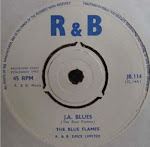
The other record company is R & B, the smallest of the three. Like Island they are selling very well still to the Jamaicans, while Melodisc are selling more to the Mods. Run by Ben Isen who also runs the R & B record shop in Stamford Hill, sales have been going up considerably. One of their top discs is “Orange Street”, an organ instrumental by Georgie Fame & The Blue Flames.

There are smaller companies, the ones who pioneered blue beat. How about the larger ones?

First of all, Decca has put out a disc called “The Blue Beat” by the Beazers. All of the small companies unanimously say “This isn’t blue beat, and if people think it is – it will do us harm”. The record itself is sung by Chris Farlow and backed by Cyril Stapleton. And no one anywhere seems to think it is blue beat. Decca are also reported to be leasing some tracks from Melodisc for release and next week will be recording some genuine blue beat groups to be put out on Decca.


PRIORITY

EMI are issuing two discs in February by Ezz Reco and the Launchers with Boysie Grant and Beverley as vocalists. This is a genuine blue beat group and if the discs are fairly successful EMI will be issuing more. But it is certainly an unprecedented step for a big record company to issue two discs by the same artiste within two weeks!

And so far no word from any other companies. So it looks as if the Blue Beat craze is destined to catch on in a big way with the two biggest record companies giving it top priority.

But once it starts breaking big nationally it looks as if the mods are going to have to find something more exclusive.

Keep your eyes open record companies…