Pass the test ! (but we won't divulge our results !!)
thanks to Alvaro & Mocky Dimples for this early article from Motor Cycle magazine Dec. 1963




Back in 1965,
Silly article, nice pics.
Christine Rout, Susanne Frost and Louise Freeman are our guides …


Boy-watching is just as popular as window-shopping, at least it seems so for Louise.

The Stephen House caters to record fans as well as to gals who buy the Mod clothes.

Well, let’s have a closer look. HER CLOTHES inside a store for HIS CLOTHES.
Why not ?
It’s common for boys to shop with their girlfriends. Each selects the other’s clothing.
“It’s as much fun to look at the boys’ clothes as it is our own. Lots of times I’ve gone shopping just looking at what the male side of our sex is wearing. That way we can tell which boys are ‘in’ when we meet them at parties or other places.”
(Which shows how Mod logic works.)

by Tony Lennane - From Blues Unlimited - April 1965 Issue
Just a few weeks short Klooks from
It is located on the first floor, bars and carpets everywhere: not the kind of place I would have expected to see T-Bone Walker.
See him I did.

This was one of Klooks better nights. By nine pm it was quite packed, though little known to the present generation of beat enthusiasts, there was quite a lot of genuine appreciation evident that night. It was March 9th; the doors were opened at 8.00 pm and we were allowed in for a very reasonable 7/- (how do they manage it ?)
Our first entertainers, and entertain they did, were the “Bluesbreakers” led by John “heart and soul in my music” Mayall, a true musician deeply involved in the true traditions of the American Negro.
I feel just recognition should be given where it is rightly due. Here is a man who knows the music, in fact a true enthusiast of the pure blues, definitely the best group we are fortunate in having here in Britain.*
After having been told of T-Bones appearance having been set for a full hour at the end of the evening between 10 and 11 pm, he appeared without warning at approximately 9 o’clock for the first of the two sets of the day.
First we were to be impressed by a five-minute guitar instrumental which, though, simple in construction , had us all rockin’. Once again credit is due to the boys for a very able backing. T-Bone told me later “they have a true feeling for the blues”.
He liked the boys, as he explained later in the bar, over a gin and orange.
The highlights of the evening were the two numbers he featured on the “Original American Folk-Blues Festival” (Polydor LPHM 237-597), “I wanna see my baby” and “I’m in love”, both among my particular favorites by T-Bone.
Other exciting – if commercial – numbers to be performed for our eager ears included the rock classic of the fifties “Linda Loo”, originally recorded by the now unheard Ray Sharp, and “T-Bone Shuffle”, an item remembered from his Atlantic label employ.
After half-time in yonder bar we pushed our weary way to the front to find John Mayall running through a few popular R n’B items – “My Babe” etc…etc…etc… T-Bone appeared to back John for a few numbers before taking the spotlight himself.
To end the night of unforgettable music we were given a form of Hooker-cum-Reed-cum-Walker “Boogie Riff”. It took 4 encores and nigh on twelve minutes before he finally disappeared behind the door, to appear very briefly with a bow and a broad smile.
This was a night never to be forgotten, and for Klooks Kleek I sincerely hope, a paying one.
More performances by visiting US artists to such as the Kleek club will undoubtedly bring out the best in all of them, thus rewarding the bluesophile with better than the average shows.
T-Bone’s tour of

the Cliffs Pavilion Southend to
the Regency Ballroom
Market Hall,
Club-A-GoGo,
Dungeon Club,
Twisted Wheel,
The Whiskey-A-GoGo,
Ricky Tick, Windsor;
Doghouse Club, Harrow;
Crawdaddy,
and many other colourful places with such names as
Cooks Ferry Inn,
Concord South Bank Jazz Club,
Public Hall,
Trade Union Hall !
Quite a selection ……
T-Bone spent two evening in full rehearsal with his group at the Marquee Club in Wardour St., London prior to his opening night at the Flamingo, which lacked the spark of his Klooks performance, a night that ignited a blaze of new interest in one of the greatest of old time bluesmen.
* Note that, as the “Bexhill Observer” so rightly says, “Any opinions stated by our correspondents do not necessarily reflect those of the editorial staff.” So don’t plague us with letters (as once happened).

Young Londoners fall into two main groups which are divided by the usual distinctions of age, occupation and money.
First there are the teenagers, referred to generically as ‘mods’. Clearly some are modder than others, but if you watch the crowd scenes in the various television programmes devoted to pop, you will get the general idea of the current fashions in this group. (Boys on these programmes whose fancy dress appears to be fancier than most, and girls of immodest appearance, are probably not mods at all but specially hired to give colour to the proceedings.) Mods like to look as much like one another as possible, and their girls are rather demure. Elder mods are sometimes as old as twenty-two. No one knows what happens to old mods because we haven’t had a whole generation of them yet. Presumably they marry, have children, and settle down to form the backbone of
Mods continue to earn more than their parents ever did when young, and they spend their money almost exclusively on pop records and clothes. The correct attitude in this group is exceedingly cool, almost blank. The young girls may scream occasionally at the pop group of their choice, and the boys may have the odd Saturday night or Bank Holiday punch-up, but emotional behaviour or any kind of frolicking is otherwise unseemly. They are not strictly chaste – but the girls are preparing for a white wedding. Mods don’t go to bistros, they prefer the Gold Egg type of restaurant. Wherever you see gigantic orange light fittings and décor which looks like one huge fruit machine, you will know that the mods are inside eating square meals in round buns. Mods’ night-life ends around midnight during the week. They have nine-to-five jobs and live at home, so they don’t go to the expensive late-night discothèques.
The mods are responsible, as principal consumers, for the progress of pop music, and the tabernacle and heart of
… The Marquee moved about three years ago from its old premises in
In
The Stones, in the days when they really were dirty, had their first central

His music was much harsher and harder than anything around now, and the Marquee then was not exactly fashionable. There were always a lot of old, ugly and unexplained people around.
Some nights the rucksack-beard-and-bedding-roll group would arrive from hitchin in some unknown Thumb Country, and there was usually a sort of habitué circle of Negroes with hip flasks dancing in front of the bandstand.
The Negroes have moved on now to the Flamingo and All-Nighter Club in Lower Wardour Street, home of Georgie Fame & The Blue Flames, and Zoot Money and The Big Roll Band.
The hitch-hikers have disappeared altogether from the beat-club scene. They were the extremist end of the Rocker tribe, which is now almost extinct. But you can still see nomads in
They are filthy and hairy and lost, and they sit there nursing their blistered feet after a trek from god knows where. Most of them grow out of it and get over it, but they suffer for their art and make a change sometimes from the neat little mass-produced mods.
These mods, the ones who care more about The Look than The Sound, congregate nightly at a place called Tiles just a block down
The music of Steve Darbishire and The Yum Yum Band, or of Everett of England, or the Anteeks, is relayed out into the street via speakers placed in neighbouring shop doorways.
Inside they dance actively, and spend their money in the night-time shops built in the maze of corridors that surround the main dance floor. The birds’ clothes shop is called Plumage, and if you’re not a success on arrival you can nip in there and come out again in something new.
On nights when there’s no live music they still crowd near the bandstand and listen to the patter of the tiny DJ. But they dance less and inspect one another’s clothing more.
The girls gather in serious little groups and tell one another the price of things, and the boys go peacocking around catching their own reflections in the glass swing doors.
Wall-to-wall mirrors in this welter of narcissism would send the sales of plumage for both sexes up by 50 per cent – or bring the whole enterprise to a halt.

... to be continued
John J. Broven
The incredulous, it seemed, had happened when it was announced that John Lee Hooker was to tour
It was not to be.
Hooker started his tour on Monday, June 4th at the Flamingo Club, after a perfunctory appearance at the Rediffusion Studios on “Ready Steady Go!”.
In the broiling atmosphere of this one-time modern jazz centre, we had a full two hours of synthetic rubbish from the Cheynes and John Mayall’s Bluesbreakers.
It was then learnt that Mayall would back Hooker, and despite protests to John Lee before the show, it was to be. Hooker appeared, and with Mayall’s organ and harmonica (yes! – he plays both at once!) striving for the limelight, he was content to strum his way through meaningless things like “Dimples”, “Boom Boom”, “Hi Heel Sneakers” and others.
In his whole act he only did two slow blues and of these, only “I’m In The Mood” came off to any degree. But most disappointing was that his guitar work was kept to a minimum.
Undaunted, I saw Hooker twice later in the tour at
Apart from a magnificent “Late Hours At Midnight” at
What went wrong?
Why was one of the greatest living bluesmen transformed into an unexceptional R&B artist?
 Obviously a lot of blame must go to whoever teamed Hooker with Mayall.
If he must have a group, OK, but not an organ! Also John appeared to be under the misconception that he was playing to a “pop” audience, judging by the stream of medium-tempo songs – which soon began to pall, being so alike.
Blues enthusiasts were definitely to the fore at the Flamingo, and if this wasn’t so elsewhere, wasn’t this the perfect opportunity to educate the uninitiated?
My opinion of Hooker has not fallen on account of this tour.
He has shown, in odd flashes, what a great bluesman he is. It’s just that this tour, for a blues lover, has been so badly presented, if financially a great success.
Simon A. Napier
If you happen to feel like writing, by all means do.
It may be worth mentioning that John, Mike Leadbitter, Graham Ackers and yours truly took JLH along on June 2nd to “
Whatever, this could have had some effect on his act, seeing the audience reaction to Chuck.
Hooker is a fine man, but he is very aware of any commercial angles and willing to put them to good use if it turns out to his benefit
From Blues Unlimited – August 1964 issue
________________________________________________
… and another view from Graham Ackers from the September issue …
Cleveleys, Nr. Blackpool 8/7/64
Wednesday, July 8th. John Lee Hooker played a most unlikely sounding venue at the Savoy Ballroom, Cleveleys. About 8.30 Dave Ward and I emerged from the bar and heard the last few numbers of the Groundhogs set. This group, previously unknown to us, was quite a surprise. They weren’t bad at all and instrumentally very like the originals.
Later they accompanied Hooker.
Then followed some noisy group of ruffians, who, after two verses of “What’d I Say” drove us barwise again!
We re-emerged slightly more amicable in frame of mind, soon dispelled by Georgie Fame and his mob. Admittedly they are technically quite adept, but what a bore the whole thing is!
We even had a Negro bashing some tom-toms, contributing less than nothing (!) – meant to add authenticity I suppose.
After this aural torture, Hooker came on to a very enthusiastic reception.
The message seems to have permeated to the far, windy shores after all.
He rolled straight into “Shake It Baby” with great power – perhaps a little too much – as a string broke after two verses!
Anyway, true to the maxim of all good showmen, he finished the number to great applause.
The next number he played with a Groundhog Fender – a somewhat unusual sight.
The Groundhog repaired his Gibson and finished the number with it.
Many followed including “Night Time Is The Right Time”, “Boom Boom”, “Hi Heel Sneakers”, “Dimples” (twice) and a blue version of “
Every number was received with enthusiasm to such a degree that five encores were performed in all.
A special mention for the Groundhogs who throughout played admirably. All in direct contrast to the “let’s see who can play loudest” approach of John Mayall and crew.
In fact everything was just right – atmosphere, backing, amplification and temperature (compared to Tropical Flamingo conditions) and everybody, including Hooker and the Hogs, had quite a ball.
________________________________________________John Lee Hooker – returned later that year for another tour …

Although it is not more than 30 years since the club closed down, the memories of the King Mojo Club in Sheffield are still fresh for the people who used to go there every week or every time that news about the Peter and Geoff Stringfellow brothers appear in the press.
The club was opened in 1964 by brothers Peter and Geoff. They were making a name for themselves thanks to the club and they were successful enough to attract the The Beatles for some shows. This success took them to sign similar bands and to promote gigs for the Rolling Stones and other British R &B bands.
The brothers were offered an old dancing hall, Day's Dance Hall, and they rented it for 30m pounds a week after refurnishing it. They choose the name Mojo after hearing the song "Got My Mojo Working" and the club soon attracted a new set of people who followed blues and soul music. It soon earned a great reputation because of the enthusiasm of the two brothers.
At the beginning, it only was open on Thursday, Friday and Saturday, but soon an allnighter was added on Saturdays, always with an American soul artist. On Sunday it was time for British R & B or soul bands, opening from 8pm until 11pm.
Sometimes, Pete and Geoff could not afford the money a great artist demanded, like Wilson Pickett, so they asked him to sing at 2am, after he had sung at a bigger club earlier the same evening. The artist always charged them less for doing so.
All-nighters began in 1965 with a one pound entrance fee and the sessions started at midnight. Soon, a regular crowd began to go, with people from Sheffield and nearby cities like

Of the two brothers, Peter was always the showman and he also liked to DJ. In 1963, ITV had started "Ready, Steady Go", where you could see lots of black artists like Major Lance, Otis Redding or Inez & Charlie Foxx. Peter Stringfellow enjoyed the programme so much that he went to the ITV offices to talk with one of the producers, Vicki Wickham. They gave Peter the task of entertaining the audience in the studio before filming began. He also controlled the dancers. He worked on “Ready, Steady, Go” for a year. During that time, every Thursday he travelled to
If you were a Mojo regular, Peter would give you tickets to the show, but I never took that offer because you had to spend a lot of time there on a Thursday and also to pay for the trip to
The Mojo soon changed its name to King Mojo. It was in
The club’s policy was to play 95 per cent of soul music and some Blue Beat and ska. At the end, there was a record ("My girl, the month of May"- Dion) that was a well known flower power track. It was covered by The Alan Bown Set, one of the main English soul bands of the time, just because of the popularity that song had at the Mojo.
Some of the records that caused an impact at the all-nighters were things like "Love a go go" by Stevie Wonder, "You've been cheating" (Impressions), "Determination" by The Contours", "365 days" by Donald Height, "Oh baby you turn me on" by Willie Mitchell, plus the singles of the time from artists like Jackie Wilson, Homer Banks or Motown. The Artistics sounds “I’m gonna miss you” was the most important song: it meant the end of every all-nighter.
The best American artists played there: Ike & Tina Turner, Billy Stewart, Alvin Cash & the Crawlers, Ben E. King, The Spellbinders, Garnett Mimms and Stevie Wonder. The best English bands also were there: Geno Washington, Jimmy James & The Vagabonds, Chris Farlowe, Alan Bown Set, Georgie Fame, Zoot Money and Jimmy Cliff (who was then still in this soul phase). Even the Small Faces had one of their first gigs there.
The stage was opposite the dressing rooms, so when the club was crowded it was a problem for the artists to go up and down to the stage. The night Ike & Tina Turner were at the Mojo, they had to push their way to the stage with the three Ikettes and the 13 piece band. That helped creating an atmosphere for every show.
Peter was a real Yorkshireman. He wanted as much as he could from every band he signed. That’s why he sometimes encouraged the audience to block the way for the artists to the dressing room until they had performed a couple of more songs. That night with Ike & Tina Turner, they had to sing three more songs. Then, he asked the crowd to let them go to the dressing room. As the club had no air conditioning, sweat and condensation fell from the walls.
Around 1966 and 1967, having a great record collection was not important for your status. To be with the in crowd you had to wear the correct clothes: Mohair suits, Levi’s, brogues shoes, leather gloves… You also had to be good at the latest dances. Then, dances changed every seven or eight weeks. The best dancers performed on the stage. If you were brave enough, you could dance on a barrel that was close to the stage.
The only problem was that it was placed on the outskirts of the town and it was complicated to get there at night. Being out there also spelt the end for it. As it was surrounded by a residential zone, the neighbours complained. In a bid to stop the complaints, no more allnighters were organised. The last one was on April 15st in 1967 with Geno
Alldayers were held on Sundays, along with live shows and more young people could go to the club. When it was clear that the police would not support a new license for the club, a show with Jimmy Cliff & The Shakedown Sound was prepared on September the 30th in 1967. We had an incredible atmosphere. The next week it was time for the last show at the Mojo: an alldayer with Stevie Wonder. This time, lots of young people were able to go and that spoiled the atmosphere a bit.
Thanks to his status in the North and the
The Stringfellow brothers did not leave the scene and opened new clubs. The old Mojo was turned into a Bingo hall and with the money from that deal, the brothers invested in a
Peter became a multimillionaire. In
The Mojo might be only a name from the past for the soul music fans of today, but I can say that the legend that was built around the Twisted Wheel in
The ads for the last all-nighter at the Mojo had nostalgic and funny lines:
And so it came to pass,
the great and famous
King Mojo All-Nighters
had to stop!
A wailing and crying as
never heard before over took
And an the last one,
Saturday XV April MCMLXVII
multitudes of all needs gathed
(except the dreaded greasers)
and paid homage.
And from in their midst
came the great Prophet:
Geno Washington & His Ram Jam Followers

A look at the latest craze to take the record industry by storm.
IT’S THE BLUE-BEAT CRAZE
Norman Jopling – Record Mirror February 15, 1964
The record industry thrives on new crazes and sounds. And at the moment three record companies are thriving on the Blue Beat craze which is just being taken up by the industry in general as a potential money spinner for all concerned

Just for the record, and for those who probably haven’t heard it yet, just what is blue beat?
Well, it’s a strictly Jamaican sound with a pulsating on-beat played on stop chords throbbing mercilessly through the disc. Most of the songs are down-to-earth items that don’t usually deal with love, and the tunes are strictly secondary to the beat.
The craze has been “in” with the Mods since last summer because of the marvellous dance beat and of course has been bought by the West Indians in
But it was only when the larger record companies heard of fantastic sales for such blue beat discs as “Madness”, “
ORIGINS
Anyway, let’s take a look at the small blue beat companies – after all on of the attractions the music had to the Mods was that the music was exclusive to the smaller and virtually unknown labels.
Firstly there’s the Blue Beat label itself. Owned by Melodisc records run by Siggy Jackson this label was formed some two years back. It boasts many of the biggest blue beat artistes including Prince Buster, Derrick Morgan and The Folks Brothers.
“The blue beat rhythm itself was started by Prince Buster” says Siggy. “He had been singing in
Although Buster invented the blue beat rhythm, I invented the name for our label.”
The other two blue beat companies don’t agree about the origins of blue beat. Both 
Island records is run by Chris Blackwell, an enterprising young white Jamaican who was fascinated by blue beat and started his own company here well over a year ago. His best seller is “Blazing Fire”, while another good one is “Housewives Choice”. Most of his numbers are recorded in
“So far all of our discs have sold well and we haven’t had one flop” Chris told me. “My aim is to see a blue beat disc in the charts – even if it was only at n°
Chris also owns two more labels. One is Sue, the great US R&B label which Chris bought when he was last in the States. Some of
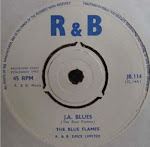
The other record company is R & B, the smallest of the three. Like
There are smaller companies, the ones who pioneered blue beat. How about the larger ones?
First of all, Decca has put out a disc called “The Blue Beat” by the Beazers. All of the small companies unanimously say “This isn’t blue beat, and if people think it is – it will do us harm”. The record itself is sung by Chris Farlow and backed by Cyril Stapleton. And no one anywhere seems to think it is blue beat. Decca are also reported to be leasing some tracks from Melodisc for release and next week will be recording some genuine blue beat groups to be put out on Decca.

PRIORITY
EMI are issuing two discs in February by Ezz Reco and the Launchers with Boysie Grant and Beverley as vocalists. This is a genuine blue beat group and if the discs are fairly successful EMI will be issuing more. But it is certainly an unprecedented step for a big record company to issue two discs by the same artiste within two weeks!
And so far no word from any other companies. So it looks as if the Blue Beat craze is destined to catch on in a big way with the two biggest record companies giving it top priority.
But once it starts breaking big nationally it looks as if the mods are going to have to find something more exclusive.
Keep your eyes open record companies…
Very interesting as well.
Spotlight on a DJ : Roger Eagle
Back in ’64 in
Over twenty years on, the Twisted Wheel is no more but Mr. Eagle is back in
In this short interview Roger Eagle tries to help us revive those Twisted Wheel days …
How did you come to be DJ-ing at the Twisted Wheel ?
I walked in there one afternoon when it was the “Left Wing Coffee Bar” with a pile of Chuck Berry and Bo Diddley imports on Chess and Checker and this guy asked me if I knew anything about Rhythm’n’Blues.
Naturally I said yes, so he asked me if I wanted to dj.
I’d never DJ-ed before but I thought I’d take a shot at it and that’s how it started.

How did you cope DJ-ing for the first time ?
I didn’t really know what to do, I just put records on and I never used to say much. But the people who used to come down were really fanatical about sounds so if it was a good record they would know what it was within seconds, it was that kind of crowd.
Was you involved with the mod scene at that time ?
I suppose I was the dj the mods would listen to if they were going to clubs because the Wheel was the allnighter scene in
We started bringing the artists over and it was amazing to see people such as Howlin’ Wolf, Otis Redding, Rufus Thomas, Muddy Waters etc… getting the same sort of reception that normally only big pop stars got.
The only thing I don’t like about the mod scene is that some people are very narrow in their tastes, we were very broadly based when we started at the Wheel. It gradually narrowed down to Northern Soul which I think was a mistake.
Did you have live bands at the Wheel ?
Yeah, we used to get American artists over to play, people such as Chuck Berry, Screamin’ Jay Hawkins, T-Bone Walker, John Lee Hooker.

Muddy Waters and Howlin’ Wolf didn’t play but they did some live stuff for the local TV station.
We had loads of them down there all the time, Jimmy Reed used to sell out the place.
When Sonny Boy Williamson came over he freaked over English girls wearing mini skirts. He was wandering around looking up all the girls saying ‘Heaven Hath Come Down’.
He was probably the greatest harmonica player of them all, maybe even better than Little Walter, which is saying a lot.
How did you know Guy Stevens ?
We knew each other, we knew what we were doing, he used to send up records.
He came up once with Inez and Charlie Foxx. He gave me a Don & Dewey single ‘Stretchin’ Out’ and he mailed me an album by Frank Frost & the Nighthawks which was out on Sam Phillips ‘Phillips International”.
I used to go to the Scene club in Ham Yard before it was the Scene but I moved up to
Where did you get your records at the time ?
Mostly I used to get them from American record companies or from a specialist import shop. I used to get records sent from the Stax label, Stan Axton the owner used to send me records.
I used to get records sent from Tamla Motown,
Roughly, what would be the Twisted Wheel top ten in 1964 ?
The favourite record of all time at the Wheel was ‘It Keeps Raining’ – Fats Domino. That was probably the most played record, then you would go to something like ‘Walking The Dog’ – Rufus Thomas.
Then you could go to any one of a dozen Muddy Waters records, probably something fairly obvious such as ‘Tiger In Your Tank’. The next on the list would be ‘That’s What I Want To Know’ – James Carr, then one of Bobby Blue Bland’s ‘Turn On Your Lovelight’.
Then would come ‘Amen’ by the Reverend Robinson and ‘Long Distance’ by Garnell Cooper and the Kinfolks which was one the rare unknown ones that we played a lot. You could pick on any one of a dozen records by Booker T & The MG’s, probably one of the more up-tempo ones such as ‘Can’t Be Still’ or something like that. There was always plenty of records from the Stax label in the top ten and also there was quite a lot of Tamla Motown floating around in there as well.
But there was not quite so much Tamla Motown as people like to think. I didn’t play that much Motown or Spector stuff just because it was so widely available and the chart stuff.
I was playing gospel stuff, but after 4 years at the Wheel it was down to that one fast Northern Soul dance beat which I tough was very boring and that’s why I left in mid ’67.


 « If you can’t dance you might as well go home. Or you have to dress really smart to make up for it. » Quick changes, like this one outside a Soho club are part of the game. Tuesday is the best night at The Scene. Monday is Mecca night (Hammersmith Palais or the Orchard at Purley), Wednesday for staying in, Thursday for washing your hair – and Friday for nothing special ? Then Saturday night-all night in the West End. « Movies or football ? » says Denzil. « We don’t have time for them, because Sunday’s meant for the Flamingo, or sleeping, and Saturday for shopping. »
 « There’s a place for choice Mods left of the band. Rockers wouldn’t dare stand there. » The choice place is at the Orchard Ballroom – which has two bars, ultra-violet lights that play on the dancers, and a blue grotto for sitting out. It costs 3s. to get in -–if you get past the ‘bouncers’ ; they know the trouble-makers.
 I don’t really mind about keeping up with the Joneses but when your friends look at you and say, ‘We’ve got a car or a fridge … » Jean (Below) who works as a hairdresser is 19. Her husband Mike is 22. He’s a post office engineer. They live in a small flat in Hammersmith, and collect stones, knives and cheap antiques. Both are Mods but they look forward to staying at home at least one night a week. Mike wears carpet slippers after work. Both of them are saving up for things. Most Mods are more worried about having a good time than a good job.


 Posts
All Comments
Posts
All Comments


